A woodworking shop can look clean at the end of the day while still holding a serious problem in the air. Fine dust from sanding, routing, and cutting may remain suspended long after the machines stop. It settles on benches, enters equipment, and can be inhaled by anyone working nearby. A quick sweep does not solve the problem.
Effective dust collection systems deal with this problem at several stages. They capture dust near the machine, separate heavier chips, filter fine particles, and help control the dust that escapes into the workshop air. Each stage has a different job. A powerful collector alone cannot compensate for poorly designed ductwork or an ineffective pickup hood.
This guide explains how cyclones, filters, ducting, and ambient air cleaners work together. You will learn how to match equipment to different machines, understand airflow and static pressure, choose suitable filtration, and maintain a system that performs reliably. The focus is practical workshop design, whether you are improving a small home shop or planning a larger professional installation.
What Are Dust Collection Systems and How Do They Work?
Dust collection systems use controlled airflow to remove airborne particles and chips from woodworking machines and work areas. A fan or blower creates negative pressure. Air enters through a hood, machine port, or extraction opening and carries dust through a hose or duct toward a separator and filter.
The basic process sounds simple, but performance depends on several connected factors. The pickup must capture dust where it is produced. The duct must carry the material without excessive resistance. The separator should remove larger debris, and the filter must retain the fine particles that remain.
A system can fail even when its motor has a high horsepower rating. A narrow hose, sharp duct bends, leaking joints, or an unsuitable hood can reduce airflow at the machine. The result is visible dust escaping around the cutting area despite the collector running continuously.
It also helps to distinguish between chips and fine dust. Large chips are easier to transport and separate. Fine particles can remain airborne, pass through poorly selected filters, and spread throughout the room. Good workshop design addresses both rather than treating all wood waste as the same material.
Why Effective Dust Collection Matters
Dust control is not simply a housekeeping issue. Wood dust can irritate the eyes, skin, and respiratory system. Repeated exposure has been associated with allergic reactions, asthma, chronic respiratory conditions, and certain cancers. Some hardwood species have been linked to nasal cancer in woodworkers.
The risk depends on the wood species, particle size, exposure level, and duration. Fine dust is particularly concerning because it can remain airborne and travel beyond the machine where it was generated.
A properly designed extraction setup reduces the amount of dust released into the breathing zone. It also helps protect motors, bearings, switches, and other equipment from accumulated debris. Cleaner machines are easier to inspect and maintain.
There is also a fire and explosion consideration. Fine combustible dust can create dangerous conditions when it accumulates and becomes suspended in air near an ignition source. OSHA identifies dust buildup, ignition sources, and poor housekeeping as important woodworking fire and explosion concerns.
For these reasons, dust control should be planned as part of the workshop layout. It should not be an accessory added only after dust becomes difficult to manage.
Understanding Cyclone Dust Collectors
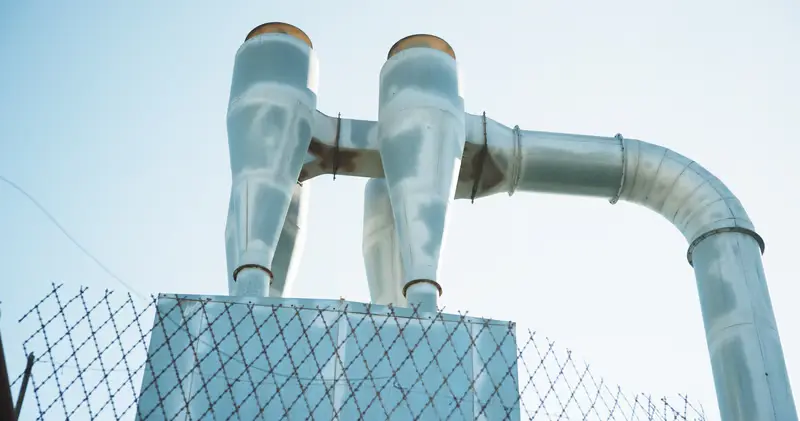
A cyclone separator removes a large proportion of heavier dust and chips before the air reaches the final filter. It uses a circular chamber and a controlled air path to create a spinning motion. Centrifugal action moves heavier particles toward the outer wall. They lose momentum and fall into a collection bin, while the remaining air continues toward the filter.
How a Cyclone Separator Works
Dust-laden air enters the cyclone through a tangential inlet. This creates a rotating flow inside the chamber. Heavier particles move outward and downward as the air follows a spiral path.
The cleaned air changes direction near the lower part of the cyclone and moves upward through an outlet tube. The separated debris drops into a sealed drum or bin beneath the chamber.
The design helps protect the filter from large volumes of chips and coarse dust. This matters when using machines such as planers and jointers, which can produce substantial amounts of material in a short time.
However, a cyclone does not remove every particle. Very fine dust may remain in the airflow and continue toward the filter. The separator should therefore be viewed as one stage of a complete extraction arrangement, not as a replacement for filtration.
When Should You Choose a Cyclone?
A cyclone is particularly useful when a workshop produces heavy chip loads or runs machines frequently. Planers, jointers, and some table saws can fill a collection container quickly. Removing larger debris before filtration helps reduce filter loading and makes emptying easier.
A cyclone also suits workshops that use a central collector connected to several machines. It can help maintain more consistent filter performance during regular operation.
The main considerations are space, cost, airflow resistance, and collection capacity. A cyclone adds another component to the air path, so the blower must be capable of overcoming the resistance of the complete system. A poorly matched separator can reduce useful airflow.
For a small shop using a sander or router occasionally, a dedicated dust extractor with a suitable filter may be more practical than a large cyclone installation.
Choosing the Right Filters for Fine Dust
The filter is the final barrier between collected material and the air leaving the collector. Its quality affects how much fine dust returns to the workshop. A collector that captures chips effectively may still release small particles if its filter is unsuitable or damaged.
Bag Filters and Cartridge Filters
Bag filters are commonly used in traditional dust collectors. Their performance depends on the filter material, surface area, construction, and particle size they can retain. Basic fabric bags may allow finer dust to pass through, even when they collect larger debris effectively.
Cartridge filters use pleated media to provide a larger filtration surface in a compact space. This can improve fine-particle capture and reduce the frequency of cleaning when the filter is correctly matched to the collector.
However, a cartridge filter is not automatically high efficiency. Buyers should check the manufacturer’s published filtration rating, test method, and operating requirements. A filter’s efficiency also depends on proper sealing. Air that bypasses the media through a damaged gasket or poorly fitted housing can carry dust straight back into the shop.
Understanding MERV and HEPA Ratings
MERV stands for Minimum Efficiency Reporting Value. It is used to compare the ability of HVAC filters to capture particles across specified size ranges. Higher MERV ratings generally indicate better particle capture, but the rating should be interpreted alongside airflow resistance and the equipment’s design.
HEPA describes a more demanding filtration category. According to the U.S. Environmental Protection Agency, a HEPA filter is designed to capture at least 99.97% of particles measuring 0.3 microns under the specified test conditions.
A HEPA rating does not mean every dust collector can accept a HEPA filter without modification. The blower must be capable of maintaining the required airflow against the filter’s resistance. The housing must also be sealed correctly.
Choose filtration based on the dust being generated, the collector design, and the manufacturer’s tested specifications. Do not rely on vague descriptions such as fine-dust filter or high-efficiency media without supporting performance information.
Ductwork, Airflow, and Static Pressure
Ductwork connects machines to the collector. Its layout has a direct effect on how much air reaches each pickup point. A powerful blower cannot perform well if the duct network creates excessive resistance.
Understanding CFM and Static Pressure
Airflow is commonly measured in cubic feet per minute, or CFM. It describes the volume of air moving through the system. Static pressure measures the resistance the blower must overcome as air travels through hoses, ducts, fittings, filters, and separators.
These measurements work together. A collector may advertise a high airflow figure under low-resistance conditions, but the actual airflow can fall when connected to a long duct run and restrictive fittings.
This is why horsepower alone is not a reliable way to compare machines. A better approach is to examine the blower’s performance curve, which shows the airflow it can deliver at different static pressure levels.
Each machine also has its own extraction needs. A small sander with a narrow port requires a different airflow arrangement from a planer that produces large volumes of chips. Check the machine manufacturer’s extraction recommendations before sizing the duct.
Designing an Efficient Duct Layout
A practical duct layout uses the shortest reasonable routes and avoids unnecessary bends. Every bend, reducer, branch, and length of flexible hose adds resistance. Long runs and restrictive fittings can reduce the air available at the machine.
Use duct diameters appropriate for the required airflow and material being transported. Oversized ducts can reduce conveying velocity if the system is not designed to move enough air through them. Undersized ducts create high resistance and may restrict the volume of air the machine needs.
Branch connections should be planned around the machines likely to operate together. Blast gates allow workers to isolate unused branches and direct airflow toward the active machine. They must be easy to reach and should close properly.
Keep flexible hose as short as practical. It is useful for connecting moving equipment, but long corrugated runs create more resistance than smooth rigid ducting. For permanent installations, suitable metal ductwork is often preferred. Combustible dust systems also require appropriate design, bonding, grounding, and fire protection measures.
OSHA guidance for woodworking extraction highlights the need for suitable duct velocities, effective hoods, and regular inspection of ducts and collectors. The required design should reflect the material and the specific equipment rather than relying on one universal airflow figure.
Capturing Dust at the Machine
The pickup hood is where effective dust control begins. It should capture particles before they spread into the room. Positioning a large collector nearby is not enough if the machine’s dust port does not intercept the material leaving the cutting area.
A table saw, for example, may need extraction below the table as well as a suitable upper guard or blade hood. A single lower port may not capture all the dust thrown above the table. NIOSH research has examined additional local exhaust hoods because conventional table saw extraction can leave significant dust emissions uncontrolled.
Sanders often need close-fitting shrouds because they generate fine particles directly at the work surface. Routers and shapers may throw chips away from a poorly positioned opening. The hood should account for the direction of the material, the cutter movement, and the operator’s access requirements.
Keep pickup openings close to the dust source without interfering with safe machine operation. A hood that is too far away allows particles to escape before airflow can capture them. A hood that obstructs the workpiece or encourages unsafe handling is not a good solution.
Shop Air Filtration and Ambient Air Cleaners
Even a well-designed extraction system may not capture every airborne particle. Some fine dust escapes during sanding, material handling, cleanup, or machine operation. Ambient air cleaners help reduce this remaining airborne dust by circulating workshop air through filters.
How Ambient Air Cleaners Work
An ambient air cleaner draws room air through one or more filter stages and returns filtered air to the workshop. Some units use a prefilter to catch larger particles and a finer secondary filter to capture smaller dust.
The cleaner should be positioned so that it circulates air through the working area without disrupting machine extraction. Placement near a ceiling or in a suitable open area may help with circulation, but the correct location depends on the shop layout and the manufacturer’s instructions.
Look at the unit’s airflow capacity, filter efficiency, noise level, and recommended room size. A cleaner with insufficient airflow may take too long to process the workshop air. A unit with poor filter sealing may also return dust to the room.
Why Ambient Filtration Cannot Replace Source Capture
An air cleaner treats dust after it has entered the room. Local extraction attempts to remove it before workers breathe it. These functions are different.
If a table saw releases a visible cloud of dust, an ambient cleaner may eventually reduce the concentration, but workers are exposed while that dust travels through the shop. Capturing it at the blade and below the table is a more direct control.
A useful workshop design combines machine extraction, effective filtration, and ambient cleaning. Personal respiratory protection may still be needed for tasks where exposure cannot be adequately controlled. OSHA recommends engineering controls as the preferred approach to wood dust management and explains that respirators require appropriate selection and a respiratory protection program.
How to Choose Dust Collection Systems for Your Workshop
Start by listing the machines you use and the type of waste each one produces. A planer creates a large volume of chips. A random orbital sander produces finer dust. A router may generate a mixture of chips and fine particles. These differences affect collector type, hood design, hose diameter, and filter selection.
Next, decide whether you need a portable or central arrangement. A portable extractor can be suitable for small tools and a compact workshop where machines are used one at a time. A central collector with fixed ducting may be more practical when several stationary machines share the same work area.
Consider the machines that may run simultaneously. The collector and duct network must supply the required airflow under the actual operating conditions. If several branches remain open, the system may distribute airflow in a way that leaves the active pickup underpowered.
Space and maintenance costs matter as well. A cyclone and large collection bin need room. Cartridge filters need periodic cleaning and replacement. Ductwork requires inspection, and collection bins must be emptied safely.
Before purchasing, ask suppliers for airflow performance at stated static pressure, filter efficiency data, compatible duct sizes, and maintenance requirements. These details are more useful than relying on motor horsepower or a headline CFM figure alone.
Maintenance and Workshop Safety
Even well-designed dust collection systems lose performance when filters clog, ducts leak, or collection bins become overfilled. A regular inspection routine helps identify these problems before they affect production.
Check the filter condition and follow the manufacturer’s cleaning instructions. A pressure gauge or differential pressure indicator can help show when filter resistance is increasing. Inspect hoses, joints, blast gates, and duct supports for damage or air leaks.
Empty collection bins before debris interferes with airflow or reaches the separator outlet. Use appropriate respiratory protection when handling accumulated dust. Avoid creating clouds by dumping material carelessly or using compressed air to blow dust from surfaces.
Combustible wood dust also requires careful attention. Do not collect hot sparks, grinding debris, or other ignition sources in an ordinary wood-dust collector. Keep ignition sources away from dust accumulation and follow applicable fire and explosion protection requirements. OSHA specifically warns against using compressed air to disperse accumulated wood dust because this can create a hazardous dust cloud.
Conclusion
A clean workshop depends on more than a powerful collector. Effective dust control starts at the machine, moves through correctly sized ductwork, separates heavier debris, and filters the remaining fine particles. Cyclones reduce the load on filters, suitable filtration protects shop air, and ambient cleaners help manage dust that escapes source capture.
The best setup depends on the machines, materials, available space, and expected workload. Match airflow to the equipment, keep duct runs practical, choose filters with verified performance, and maintain every part of the system. A carefully planned arrangement makes the shop cleaner, protects equipment, and helps reduce workers’ exposure to hazardous dust.
FAQs
1. What is the difference between a dust collector and a shop vacuum?
A dust collector generally moves larger volumes of air and is designed for machines that produce substantial chips and dust, such as planers and jointers. A shop vacuum produces stronger suction through smaller hoses, making it more suitable for sanders, routers, and portable tools.
2. Do I need a cyclone separator for my workshop?
A cyclone is useful when machines generate large quantities of chips or when frequent filter clogging is a problem. It separates heavier material before the filter. Small workshops using only a few portable tools may find a suitable extractor and pre-separator sufficient.
3. What filter rating should I choose for fine wood dust?
Check the filter’s tested efficiency and the particle sizes it captures. A HEPA filter has a defined efficiency of at least 99.97% at 0.3 microns. Confirm that the collector can maintain suitable airflow with the selected filter installed.
4. Can an ambient air cleaner replace machine dust extraction?
No. An ambient cleaner filters particles that have already entered the room. Machine extraction captures dust closer to its source and reduces the amount released into the breathing zone. Both can support a cleaner workshop when used correctly.
5. How often should I clean or replace dust collector filters?
Follow the collector manufacturer’s instructions and monitor filter condition, airflow, and pressure drop. Heavy use may require more frequent cleaning. Replace damaged or exhausted filters when cleaning no longer restores performance or the manufacturer recommends replacement.